Active recall best study technique


There are lots of study techniques that you may follow like reading your textbook, making flashcards, highlighting written notes, listening to podcasts, or watching your favorite online videos. However, we often do not know which revision technique is the most effective and maximize the working efficiency. Also, ensure that the best possible chance to crack that next exam. A wealth of scientific research collected over half a century tells us that the vast majority of students still use the least effective study techniques. But I’m sure this doesn’t apply to you, does it? Multiple studies (like this one and this one) have shown that reading and re-reading notes remains the most popular study technique utilized by higher education students. Many of you will recognize the truth in this; I have relied on reading and re-reading my notes to pass exams throughout school and university. So, if it ain’t broke, don’t fix it, right? Wrong. Despite its popularity, scientific research consistently and emphatically emphasizes the following point: Reading and re-reading notes is classed as an ineffective, time-consuming study technique that does little to significantly improve memory retention and academic performance. A comprehensive 58-page meta-analysis investigating the efficacy of ten different study methods concluded that passive learning techniques, such as re-reading, highlighting, and summarizing notes, were all low-utility methods. Put simply, passive study techniques do little to engage your memory retrieval or test your knowledge. In particular, re-reading your notes ranks as one of the most ineffective ways to learn, study for an exam, or retain information in your long-term memory. So why are they so popular? Essentially, they’re easy. Reading and highlighting your notes is easy. On top of that, it feels productive. We love reading a sentence and halfway through realizing, “Oh, yeah I recognize this!” It feels good and gives us this false sense of confidence that we understand the topic. But if someone were to ask you unprompted for the clinical feature pathognomonic of acute tubular necrosis, chances are you would draw a blank. Because there is a big difference between actually remembering information and simply recognizing it. So, let’s explore what is widely regarded as the most effective, high-yield learning technique: active recall. Active recall (a.k.a. active retrieval or practice testing) is a study method that flips the original way of learning on its head. Traditionally, students learn by trying to put information into their brains. With active recall, you learn by retrieving information from your brain. Although this may sound strange, in practice, it is very straightforward. The active recall involves taking a topic you wish to learn, creating questions based on that topic, and then repeatedly testing yourself on those questions. By forcing your brain to retrieve the information, it ensures that you actively learn it instead of passively reading it. Not only are you significantly more likely to remember the information, but active recall also makes you acutely aware of topics that you do not understand and that require additional attention. Since incorporating active recall over the last few months, I have already noticed a difference in my understanding and knowledge. The pathophysiology of a condition is easily accessible, the key clinical features no longer elude my memory, and the first-line medication comes with little prompting. Getting lots of practice at answering questions is also great preparation for life on the wards as a junior doctor. Whether you are getting grilled by the on-call consultant or racking your brains for the most important causes of loss of vision, being able to recall information quickly and accurately is a crucial skill best mastered sooner rather than later! As I mentioned previously, active recall is widely regarded in the scientific literature as the study technique that improves exam performance the most. The same 58-page meta-analysis on study techniques ranked active recall (named practice testing in the paper) as a high-utility study technique. Another two studies (this one and this one) evidence how students using active recall significantly outperform students that use passive study techniques, such as re-reading notes. How can YOU incorporate active recall?
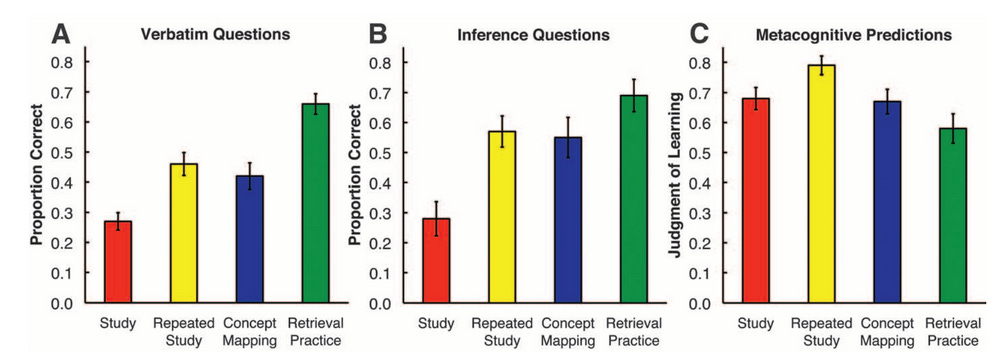
It can be easily incorporated into your current study in some ways. My method involves taking whatever learning resource you use—whether it be lecture slides, Osmosis videos, or your written notes—and making a list of concise questions based on the content. When you next revise that topic, go straight to the questions and answer as many as you can without reading your notes. Any questions that you get wrong, go back to your notes afterward until you can answer the question correctly. Color-coding the questions based on whether you got them right (green) or wrong (red) is a helpful way of tracking progress. Integrating spaced repetition into your topics and questions is another scientifically-validated way to boost memory retention. Online question-based resources can also lend a helping hand.
Collected from: Google